
Airplane Mode IP - owner of the AIRPLANE MODE® Intellectual Property (IP). The official source.
The Odin Programme: The First Modern Smartphone
Innovation Seven Years Ahead of the iPhone
In the year 2000, while the mobile industry focused on monochrome screens, a specialised team led by Rob Lowe developed the Odin Smartphone. This device was not a concept; instead, it was a fully operational smartphone that introduced 80% of the technologies used in modern devices today.
World-First Technical Specifications
Furthermore, the Odin Programme achieved several “Civilisational Inventions”. These breakthroughs permanently changed how the world interacts with technology:
- Portrait Touchscreen: Features a high-resolution Sony TFT display, moving away from landscape designs.
- App Ecosystem: Native downloadable applications, including Word and 3D gaming, years before the “App Store”.
- Mobile Internet: The first practical use of GPRS for web browsing and live email synchronization.
- Wireless Syncing: Implementation of SyncML for data backup, the precursor to modern cloud services.
The First Modern Smartphone Software Suite
In addition to hardware, the Odin project pioneered a robust software experience that defined the era. Specifically, the device utilized the first modern smartphone operating system to support professional-grade mobile internet through the Opera browser. Furthermore, it featured an integrated email client and multimedia messaging, allowing users to stay connected while on the move. Consequently, these features transformed the mobile phone into a handheld computer, meeting the exact definition of a smartphone seven years before the mainstream market caught up.
The Invention of Airplane Mode®
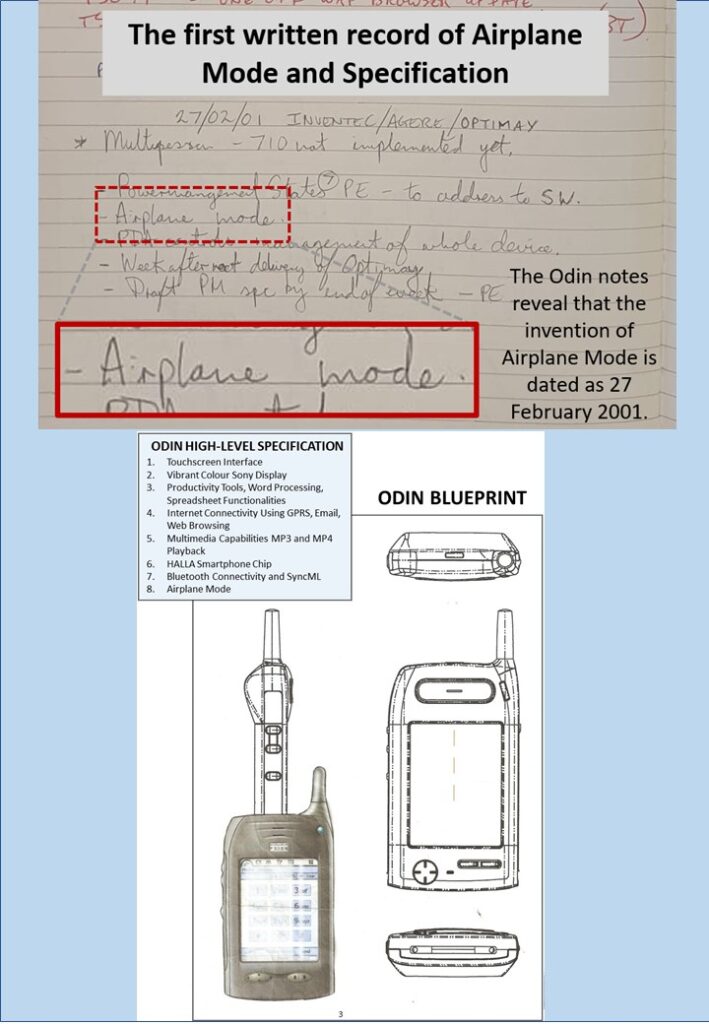
Most importantly, Rob Lowe coined and recorded the term “Airplane Mode” on 27 February 2001. This world-first technical requirement allowed passengers to safely use multimedia features during flight. Today, this trademarked innovation remains a global standard for billions of people daily.
Verified Historical Archive of the First Modern Smartphone
To prove this history, Rob Lowe preserved 115 pages of original, handwritten engineering notes. Recently, The National Museum of Computing (TNMOC) at Bletchley Park, officially archived these documents. Therefore, this collection ensures Odin’s rightful place as the landmark that established the first modern smartphone era.
“Odin changed everything—before the world was ready.”